From Business Intent to Working Systems
A company does not become more capable simply by adding tasks, software or agents. It becomes more capable when it can turn a useful intention into a way of working that people understand, systems can support, and experience can improve.
Workflow design is the discipline that connects those things. It asks what result matters, what must be true to produce it, who can do the necessary work, and what should happen when reality does not follow the happy path.
This is as relevant to a customer service operation as it is to an AI engineering project. Design makes the route to a valuable result understandable, testable and manageable.
In Brief
Start with the result and work backward to its prerequisites. Remove work that serves neither the result nor a necessary constraint. Allocate the remaining work according to capability and responsibility, rather than assuming that every task needs an agent. Draw the important choices, dependencies and exceptions. Then bind the drawing to real people, data and tools, and inspect what happens in use.
A good workflow makes success recognizable and failure recoverable. It cannot guarantee that a hypothesis is true, that a customer will be satisfied, or that a business will succeed. Its value is that those questions stop being hidden inside a stream of activity.
The business process management foundations here draw on Dumas, La Rosa, Mendling and Reijers’s Fundamentals of Business Process Management. The application to collaboration between people, AI agents and software is the perspective developed in this essay. It is not a classification or an AI operating model supplied by the textbook.
1. Define The Result Before The Route
An activity describes work. An outcome describes a meaningful change for someone.
“Review the request” is an activity. “The customer receives a justified decision and, when eligible, a usable replacement” describes an outcome. The distinction changes the process boundary: producing an internal decision is not the same as delivering the service.
Consider a hypothetical company that supplies office devices. A customer reports a faulty device and asks for a replacement. The example throughout this essay is independently constructed for explanation; it is not a customer case or evidence of commercial improvement.
The process starts when a request arrives. A successful replacement case ends when the customer has received a usable replacement and the service record reflects that result. A request outside the service terms has a different legitimate ending: a correct explanation and the available next option. A pending investigation, unresolved shipment or unanswered approval is not either of those endings.
Before drawing, the designer needs a few consequential answers. Which service promise applies? What evidence establishes eligibility? Who can make an exception? What counts as proof of receipt and usability? What happens if the customer does not reply? The point is not to ask every imaginable question. It is to resolve the assumptions that would change the route or its definition of success.
The objective also needs an order of priorities. This service might seek faster resolution, but not at the cost of sending the wrong device or repeatedly creating shipments. Time, cost, quality and the ability to handle unusual cases can pull in different directions. A target without those constraints invites the process to become efficient at the wrong thing.
Keep that intent visible during the work. If new evidence makes the result infeasible or undesirable, reopen the assumption rather than silently changing what success means.
For an existing service, understand current practice before designing its replacement. Follow a few recent cases with the people who handled them, including an ordinary case and one that returned for correction or remained unresolved. Ask what actually happened, who received the work, what they waited for and why they sent it back. Compare their accounts with available messages, case records and physical observations. A written procedure describes what should happen; an interview supplies one person’s account. Neither alone establishes what happened.
Keep a short case trail: request -> evidence gathered -> decision -> handoff -> ending, with waits, returns and uncertain facts marked. Separate observed practice, prescribed policy and proposed changes. For example, a customer may appear slow to reply when the case record shows that nobody sent the clarification question. Those diagnoses require different repairs. The agent can assemble the trail and expose gaps; participants confirm or correct it. For a genuinely new process, start with explicit hypotheses instead of inventing a history, then test them in a bounded first use.
Understand What The Business Must Be Able To Do
Before arranging tasks, ask whether the necessary work exists. The replacement service also needs an applicable promise, stock and decision capacity, observation of unresolved requests, and someone able to intervene. A logically correct route can lack these supporting activities.
BCS’s Business Analysis distinguishes a conceptual business activity model from a process model. The first asks what activities a particular view of the business requires; the second explains how a case proceeds. Planning, providing resources, doing the work, observing results and correcting problems are useful prompts for the first question. They are not five compulsory workflow stages or a new execution notation. Monitoring and correction can continue across many cases.
Different views may imply different work: predictable dispatch batches for the warehouse, urgent replacement for the customer. An agent can expose the conflict; responsible people must reconcile it or decide. Several agents agreeing does not settle the service promise.
Compare the necessary activities with actual practice. A reliable activity, an ineffective activity, a demonstrated absence and an activity not yet investigated are different findings. A missing record alone does not prove missing work. Use the distinction to choose the next inquiry or repair, not to produce a catalogue of every activity in the company. A narrow, well-understood correction may need none of this additional modelling.
2. Work Backward Through Dependencies
Before settling on a route, separate the need from the proposed means. “Make the agent approve replacements” names a design; “give eligible customers a timely, justified decision” names the need it might serve. The proposed design may be an agreed constraint, a preference or an untested suggestion. Explain the distinction when it could change the decision, without silently replacing an explicit owner choice. A small design sketch can reveal another missing need, so understanding and design may develop together. This is not a demand to reopen every accepted correction or consider every conceivable alternative.
The most revealing question is often not “What do we do next?” but “What must already be true for this result to be valid?”
For a usable replacement to reach the customer, the correct item must be selected and dispatched to a confirmed destination. Dispatch requires authority, available stock and a valid shipment request. Authority depends on the applicable service terms and the facts of this case. Those facts depend on identifying the device and obtaining enough information about the problem.
This backward reasoning is informed by the textbook’s treatment of Product-Based Design, which derives possible processes from the information needed to produce a result. Here it is used as a lightweight design technique, not as a reproduction of that method’s formal models or tools. Physical delivery also has constraints that cannot be reduced to information dependencies alone.
The result is a dependency structure, not yet a schedule. Some facts can be obtained independently; others cannot. An agent cannot make a reliable eligibility recommendation before the relevant contract is identified. A warehouse should not dispatch merely because a draft recommendation sounds convincing.
Once the dependencies are known, there may be several valid routes. The company could check eligibility before looking for stock, avoiding unnecessary stock work for ineligible requests. Or it could check eligibility and availability in parallel, reducing delay for eligible customers at the expense of doing some work that may not be needed. Which is preferable depends on demand, effort, stock policy and the service promise. “Parallel” is not a synonym for “better.”
This is also the moment to remove unnecessary work. Asking a customer for information already held reliably in the service record creates friction without creating knowledge. Repeatedly transferring the entire case between teams can consume time while adding no decision. But an independent check, a permission boundary or a legally required record is not waste simply because it slows the route.
The same reasoning applies to knowledge work. A useful analysis needs an answer to a question, supported by appropriate evidence and an explanation the reader can use. Ten reports are not ten prerequisites merely because ten agents are available. Design the necessary knowledge dependencies first; choose the research activities afterward.
3. Assign Work By Capability And Responsibility
A workflow needs both a performer for each activity and someone accountable for the whole result. Otherwise, every participant can finish a local assignment while the case remains unfinished.
For the replacement service, the case owner sees a particular request through its legitimate ending. The process owner maintains the service’s rules, resources and improvement decisions across cases. One person may hold both responsibilities in a small team, but they are different jobs. Neither requires personally performing every step or approving every ordinary decision.
The useful distinction is between three kinds of contribution:
| Contributor | Suitable work | Important boundary |
|---|---|---|
| Software | Retrieve authoritative records, apply explicit rules, reserve stock, track case state and execute supported operations | A rule is only dependable when its inputs, implementation and authority are dependable. |
| AI agent | Interpret a customer’s description, organize evidence, identify ambiguity and draft a reasoned proposal | A plausible explanation is not proof of a fact or permission to act. |
| Human | Resolve consequential ambiguity, decide exceptions, provide physical observations and judge whether the result is useful | Human review needs usable evidence, a clear decision and a practical response path. |
An API is an interface to a capability, not a fourth kind of accountable colleague. The system behind it may own the operation; the workflow still needs to specify who is allowed to request it and how its result will be checked. A person clicking through a software screen is still doing human work.
In this example, an agent organizes the fault description and flags uncertainty. Software retrieves the service terms and stock information. Clear, authorized cases may follow an established rule without a fresh manager decision. An exception or unresolved interpretation goes to the designated human. Warehouse staff confirm the physical item before dispatch. The agent does not acquire shipment authority merely by recommending a replacement.
For any important handoff, a sentence is often enough to expose the contract: given these inputs, this performer produces this result for this recipient, with this check and this failure route. Add the input revision or decision record when changing information could invalidate later work. There is no benefit in turning every trivial action into a specification, but consequential assumptions should not live only in someone’s memory.
4. Draw The Decisions, Not Just The Tasks
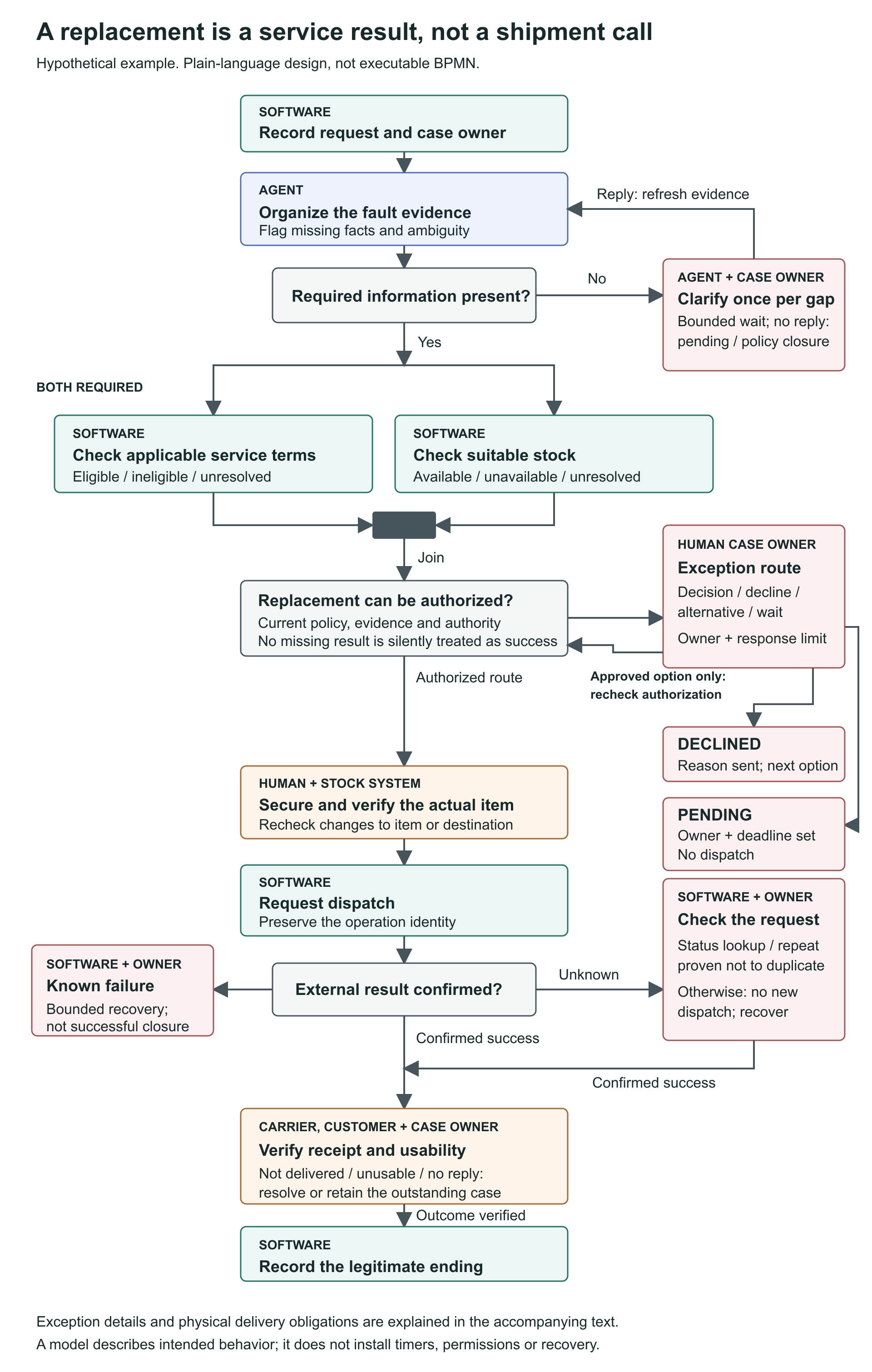
A useful diagram answers questions that a task list cannot: what is conditional, what can happen independently, what must finish before the next action, and where an unsuccessful case goes.
The diagram shows a simplified replacement route, not executable configuration or formal BPMN. Declined and pending cases leave the main success route; only an approved option returns for an authorization recheck.
Make Arrow Meaning Explicit
BPMN, the Object Management Group’s process notation, is useful because it gives familiar-looking arrows and symbols precise meanings. The earlier diagram remains an informal explanation. A formal model needs the notation’s actual rules, not just its appearance; a short everyday route need not use BPMN at all.
Start with the interaction boundary. The replacement company and its carrier can be shown as separate participants, or Pools. The company’s case owner, agent and dispatch system can be organized into Lanes inside its own process. Sequence arrows show that process’s order; messages cross between participants. Lanes categorize work, but do not establish permissions or compel a particular human/agent/software organization. A link to an address record describes data, not a command to dispatch.
This distinction exposes a practical question: sending a shipment request is work the company controls; the carrier’s response is something it must receive and associate with the right case. Drawing one uninterrupted sequence through both organizations can hide that dependency. Naming the message, recipient and expected reply makes the handoff discussable without pretending to know the carrier’s internal procedure.
At a choice, the workflow selects a route using known information. Eligible, ineligible and unresolved are different results; unresolved should not be quietly treated as eligible or ineligible.
At a parallel split, the workflow launches independent obligations. At the matching join, it waits for the obligations actually required by that route. In this example, eligibility and stock results are both required before authorization. A failed lookup must yield a visible unresolved result or recovery route, not disappear and leave the join waiting indefinitely. Both required results can be present even when one says “not eligible” or “unavailable.”
Check Joining And Stopping Scope
Two arrows entering a task do not necessarily mean “wait for both.” In BPMN, separate arrivals at a task can enable separate executions; an exclusive merge does not synchronize them. For the replacement service, eligibility and stock must feed an explicit join before authorization. Otherwise, an early stock result could start authorization prematurely, and the later eligibility result could start it again. Check both the missing-result case and the double-arrival case, rather than assuming visual convergence makes one continuation.
When only some checks are requested, a simple structured design can wait for that selected set. More complicated loops and overlapping routes need closer analysis; “wait for the branches we started” is not a complete rule for every inclusive join. Simplifying the route can be more useful than adding another symbol.
Stopping also has scope. A reminder while waiting for an exception decision should not silently end that wait. An interrupting event stops its attached activity, whereas a terminate ending stops work in its containing scope. An ordinary end on one path does not stop other active paths. The designer must say which behavior is intended and which obligations remain. None of these drawing choices proves that an external shipment was canceled or returned.
Finally, a default branch does not discover missing facts. Conflicting coverage dates still need an explicit unresolved route, not permission inferred from a fallback. These distinctions help the agent explain what the model means; implementation and service policy must supply what actually happens.
A wait is different from a choice. Waiting for a customer reply means the deciding information has not yet arrived. Design the response deadline, how the responsible person is notified, what happens at expiry and how a late reply is treated. Writing “wait three days” on a drawing does not create a timer or an escalation mechanism.
A loop needs a reason to repeat and a way to end. Clarification should not repeatedly ask the same unanswered question. A bounded attempt to resolve it can end in a pending case, an authorized alternative or an explicit closure under the service policy. It should not manufacture a successful replacement merely to finish the workflow.
The diagram’s main line is therefore only part of the design. A readable model can hide detailed sub-processes, but it must preserve their inputs, outputs and possible endings. Simplicity should reduce visual noise, not erase obligations.
5. Design For The Cases That Do Not Cooperate
Exceptions reveal whether the process is designed or merely hoped for. They should be specific enough to change what the next participant does.
For the replacement service, the exception route has these distinct behaviors:
| Situation | Designed response |
|---|---|
| Device identity or fault evidence is missing | Ask for the specific missing information. On the agreed response deadline, notify the service owner and follow the stated pending or closure policy. Preserve the unresolved facts. |
| Eligibility is unresolved or an exception is requested | Send the evidence and precise decision to the authorized human. No reply does not authorize dispatch; retain the case and apply its escalation deadline. |
| The request is ineligible | Provide the reason and available next option. Record a declined case, not a delivered replacement. |
| Stock is unavailable | Offer an authorized alternative or wait with a named owner and update condition. Do not turn an availability query into an indefinite reservation. |
| The destination or replacement item changes | Invalidate the affected authorization or shipment preparation and recheck it. Retain unaffected evidence rather than restarting everything. |
| A shipment request times out | Preserve the original request identity and determine whether the operation took effect before issuing another. |
| A parcel arrives, but the replacement is unusable | Reopen the service outcome. Shipping success did not meet the promised result. |
A timeout means that an answer did not arrive, not necessarily that nothing happened. The carrier may have accepted the shipment. Check the original request through an authorized status lookup before sending another. If dispatch is confirmed, continue from that result. A repeat is safe only when the service explicitly supports repeating the same request without duplicating its effect: keep its original identifier and contents, and check that permission and limits still apply. If neither the result nor a safe repeat can be established, stop new dispatch requests and obtain an authorized recovery decision. A confirmed failure and an unknown result need different routes.
Canceling unfinished work is also different from reversing completed work. Stopping a preparation task does not retrieve a parcel already handed to a carrier. Recovery may require an interception request, return or other compensating action, each with its own permission, cost and limitations. A diagram cannot promise perfect rollback.
For an agent, uncertainty about facts should trigger verification or a bounded request for help. It should not be converted into certainty by another confident paragraph. Nor does an agent’s self-reported confidence substitute for a tested decision rule.
Make uncertainty useful to the decision. Ask which plausible change in an uncertain fact would change the recommendation, and say when that effect is unknown. In the replacement case, conflicting coverage dates prevent an eligibility decision; they need not prevent collecting the fault description. In a cost comparison, uncertain repair costs might reverse the proposed choice. The reader needs that condition alongside the recommendation, not buried in a footnote. Seek more evidence when it could change the next action; otherwise, a clearly limited conclusion may be sufficient. Do not invent a numerical confidence level to make an unknown look measured.
The goal is not to model every possible disaster. Focus on the failures that threaten the outcome, create material harm, strand the case or trigger costly repetition. A small reversible text correction can use a direct route. A shipment, payment or irreversible external change needs stronger recovery design.
Keep One Failure From Taking Over The Route
A carrier slowdown can strand more than one replacement case. If every waiting request occupies the same limited worker capacity, unrelated cases and the recovery team may also be unable to proceed. Design how much work can enter the constrained step and how waiting cases remain owned. Protecting some capacity for other obligations can help, but separate workers may still depend on the same unavailable service.
Repeating an attempt at several levels compounds the problem. If both the case coordinator and its shipment tool independently retry, the carrier may receive more requests than either participant’s local allowance suggests. Count the combined attempts and respect the shipment’s unresolved effect, rather than adding another retry layer. A stopped stream of new requests is not a completed service; waiting customers still need a truthful status and a next responsible action.
Recovery needs evidence too. A status page may respond while shipment requests cannot complete. Recently completed cases may look fast while older requests remain stuck. Observe useful progress and unfinished work, and allow for the delay before a corrective action becomes visible. When the carrier recovers, releasing the entire backlog can overwhelm it again. Resume through a supported, capacity-aware route and verify that cases reach their legitimate endings. For a consequential change, a small authorized test of slowdown and resumption can challenge these assumptions; this does not require breaking a live service. The distinction between component health and useful service, and the attention to shared resources and recovery, draw on Michael Nygard’s Release It!.
6. Check The Model, Then Make It Real
A Decision Needs A Working Control Path
A sequence says which task follows another. It does not show whether someone can change what happens, or learn that the change took effect. The control-and-feedback perspective in Nancy Leveson and John Thomas’s STPA Handbook adds those questions. Start with a result to avoid and the condition that must hold to prevent it, rather than listing every imaginable malfunction.
In the replacement service, one unwanted result is dispatch to an outdated address. The condition is that dispatch uses the currently confirmed destination under valid authority. Suppose the customer changes the address while an earlier shipment decision is still queued. The dispatch participant may believe the old decision remains valid, although the actual case has changed. A fresh “hold” message and an older dispatch instruction may reach different participants. Both messages can be delivered correctly while the combined service behaves incorrectly.
Ask what happens if a needed intervention is omitted, a harmful action is taken, or a correct action arrives too late or in the wrong order. Where a control must remain active, also consider ending it too soon or retaining it too long. An exception escalation that nobody sends before a carrier cutoff is different from an incorrect eligibility answer. Requesting cancellation is different from confirming that dispatch was stopped.
For each relevant case, identify what information the responsible participant needs, whether it describes the current case, and whether that participant has the authority, capability and time to respond. Trace the response to its observable effect. If that effect cannot be established, retain the uncertainty and use the authorized recovery route; do not label a sent message as a successful intervention.
Prefer preventing an invalid dispatch where feasible over adding another warning. A remaining safeguard depends on assumptions: perhaps address changes can still stop queued work. Identify what would invalidate that assumption, when it should be checked, and who can take a practical next action. A disabled safeguard must not remain silently described as protection. These are selective design questions, not the complete STPA method or a guarantee that every hazard has been discovered.
Before committing expensive work, walk concrete cases through the route. Ask where each ends, what evidence it carries and who remains responsible.
A Filled Walkthrough
Suppose the example service has a published rule: a verified fault within the coverage period permits a like-for-like replacement, without a new manager approval. This is an invented teaching assumption, not a recommended universal policy.
One request identifies device D-17, describes a power failure and confirms the delivery address. The case owner asks the agent: “Show what is known, what is missing, and which route this request can take under the service rule.” The agent organizes the description; the service record confirms active coverage and the required fault check confirms the failure. Software returns an available matching item. Both results are present, so the established rule authorizes replacement. The agent’s recommendation alone does not.
The handoff to the warehouse contains the authorized decision, matching item and confirmed address. Its required output is the secured, physically verified item, returned to the dispatch system with any mismatch flagged. Software then requests dispatch and retains the shipment reference. The carrier records receipt and the customer confirms that the device works. The case owner checks this evidence; the service record closes as a usable replacement received. A shipment reference alone would not close it.
Now change one fact: the service record contains conflicting coverage dates. Eligibility becomes unresolved even though stock is available. The agent sends the conflicting records and the precise question to the authorized exception decision-maker. No answer by the service’s response deadline leaves an owned pending case with escalation, not permission to dispatch. If an exception is approved, the case returns to authorization with that decision; if declined, the customer receives the reason and next option. This small variation tests whether the diagram preserves uncertainty instead of hiding it.
Your First Application
Give each branch its own ending. If a customer cancels before dispatch, the expected result is a canceled case with no new shipment, not the success path’s usable replacement. If a previous dispatch is unresolved, cancellation must retain that outstanding obligation. A single list of successful postconditions beneath several alternative paths can hide this difference. Check that the explanation, available actions and expected final state agree.
Bound quality promises as well. “Works with every device” is not a usable compatibility requirement unless the supported set is actually known. State which devices or environments are supported, which conditions the check covers and what remains outside that promise. Likewise, “fast” needs a relevant case mix and measurement boundary before it becomes a target. Do not invent a number merely to make the requirement look precise. A modest, testable promise is more useful than an unlimited one nobody can verify.
Choose one manageable process and name its recipient and useful result. Trace recent cases if it already exists. Ask an agent to propose the prerequisites and a short diagram showing people, agents, software, waits and failure routes. Correct its business assumptions with the participants, then walk one ordinary case and one changed fact through it. Fix consequential gaps before a bounded trial; compare the trial’s outcome and effort with the current route.
This check has three separate questions, reflecting the textbook’s treatment of process model quality:
- Behavior: can the route progress without dead ends, accidental duplication or endless repetition?
- Meaning: does it match the actual service promise, permissions, data and physical work?
- Use: can the participants understand their next action and the evidence they need?
A second person or non-authoring agent can challenge the model; knowledgeable participants still need to confirm the business assumptions. A walkthrough is useful evidence, not proof of live execution.
When discussion cannot settle an important uncertainty, try the smallest experiment that can change the decision. For the replacement service, that might mean testing whether a person can find the cases needing a decision in a realistically crowded queue. Compare different arrangements if layout is the uncertainty, rather than polishing one empty screen. Preserve the question, what was tried, what was observed and the resulting choice, with evidence the person can inspect. A prototype supports that choice; it is not a production service or proof of customer value.
Make Expectations Concrete
Saying “the replacement is correct” leaves room for several incompatible interpretations. A few concrete examples make the agreement inspectable. Under the invented service rule above, a verified fault during coverage should lead to exactly one matching replacement for the identified customer and confirmed address. A request with conflicting coverage dates should remain unresolved, with no dispatch. The examples clarify the important relationships, not merely whether some parcel exists.
Discuss those conditions with the people who know the service promise. An agent can suggest examples and expose missing questions, but several agents agreeing does not establish stakeholder agreement. Ask what would happen if one important fact changed. Keep only enough detail to explain the rule; a large table of every imaginable combination can obscure the conversation it was meant to support. A yes/no result is useful when its meaning is defined, and an acceptable range may be more honest than a single exact value.
This approach draws on Gojko Adzic’s Specification by Example: concrete examples help participants discover whether they mean the same thing before implementation. It is not a requirement to adopt a particular test tool or hold a workshop for every correction. When a larger change is split into small pieces, retain an example of the complete service outcome. Correct pieces do not necessarily add up to a usable replacement.
Some agreed examples can become automated checks. Their expected answers must still come from the service rule or another justified reference, not simply repeat the calculation being checked. That independent-answer discipline is the engineering application developed here. Reusing system operations to create valid test state is different: a check that invents an impossible authorization state may miss the very transition that fails in practice. Isolated checks are useful, but they do not establish what omitted interfaces or people will do.
Maintain the readable rule, its examples and the relevant checks together as the service changes. Otherwise, the explanation can promise one thing while tests approve another. This is the idea of living documentation: maintained descriptions connected to checks of actual behavior, rather than a growing archive of old requests. Where a property cannot be checked automatically, keep its manual observation and limitations explicit. Examples do not replace exploration, usability testing or judgment about whether the service is valuable.
A separate evaluator is another fallible participant. Calibration means checking whether its judgments match the agreed criteria on concrete examples. If it approves an explanation that omits the required service decision, keep that disagreement and improve the relevant criterion. If an adequate short explanation is rejected only because it lacks an unrequested table, the criterion also needs attention. Do not lower the agreed standard to obtain agreement. Examples used to adjust the evaluator must be followed by different checking cases; agreement on rehearsed examples is not enough. Recheck the affected judgments after a substantial model, tool or criterion change.
The evaluator also needs access to the property being judged. Reading the service record can reveal missing evidence, but cannot establish that a physical replacement works. Watching a recording without sound cannot establish audio quality. A property that was not observed remains unassessed, not passed and not automatically defective. Select a suitable check or retain that limitation in the result; another confident review does not create the missing observation.
When an agent drafts a workflow, the human should not have to become a notation expert to evaluate it. The agent should explain the decisive branches, identify its assumptions and ask questions about meaning. The human can then say “that condition is wrong” or “this decision belongs elsewhere” without redrawing the diagram.
The same consideration applies when a change is delivered. Explain the meaningful difference and the evidence for it, identify affected participants and state important remaining risks. Where feasible, compare the promised behavior before and after the change. A layout image can make a crowded queue understandable, but cannot establish that only authorized people can approve a shipment. Choose the observation for the claim; do not make the reader reconstruct the argument from a pile of test results.
Making the model real requires more than choosing a workflow tool. Identify the authoritative service record, the rule used for eligibility, the actual stock operation, the shipment interface, the work queue for human decisions and the evidence that permits closure. Define who maintains those bindings and what changes invalidate them.
For the example, a short case record might retain the device identity, evidence, applicable service terms, eligibility result, stock or reservation state, authorization, shipment operation identity and delivery outcome. Store what is needed for execution and diagnosis; restrict sensitive information and avoid collecting it simply because a model can log it. The relevant state must survive a chat ending, a worker replacement or a system restart.
Different workflows need different coordination strength. A stable service transaction may use a fixed route. An investigation may need flexible next steps as findings arrive, while keeping the question, constraints, evidence and stopping conditions explicit. Software should enforce the boundaries it can reliably check; agents should retain room for justified reasoning inside them. Neither an unrestricted agent nor a rigid script is the universal answer.
Existing business systems may already provide much of this support. Use them where they fit. A new process engine, simulation platform or multi-agent architecture is not a prerequisite for good workflow design.
A working destination also needs a workable transition. Suppose the replacement service moves from separate spreadsheets to a shared case record. New requests might follow the new route while older cases still need their evidence, shipment references and responsible people preserved. Decide how those cases are handled, what preparation the users need, and what establishes that the temporary arrangement can end. Do not close old cases merely because a new system exists. These temporary requirements are different from the lasting service rules; an ordinary text correction needs no transition plan.
7. Measure The Journey, Not The Activity
The workflow on paper is an intended design. Records of its use are observations. A reconstruction from those records is an inference. Keep the three separate.
For the replacement service, measure the time from request to the legitimate ending, the share of replacement cases with a verified usable delivery, relevant exceptions, rework and total effort. Separate accepted, declined, pending and reopened cases. Define the observation window and denominator; otherwise, improving a reported rate may simply mean excluding difficult cases.
Track enough timing to distinguish active work from waiting when the evidence supports that distinction. A gap between two completion events is not automatically queue time. It may include unrecorded customer contact, overnight time or physical handling. Missing events are missing evidence, not proof that nothing happened.
Recommendations, API calls and dispatches are intermediate events, not usable replacements. A correct rejection is a legitimate service result, but not a replacement success.
Keep three claims distinct: the capability works under the checked conditions; the complete process performs better; and the improvement creates value for its recipient. An eligibility tool may return correct answers faster while customers still wait just as long for a usable replacement. Establishing that first capability can complete a deliberately limited engineering task, but does not establish the other two claims. Evaluate the level promised by the assignment, retaining its quality, safety and effort constraints, rather than demanding a business-value study for every small correction.
Total effort includes people, agents, tool calls, coordination and repair. Parallel work can reduce elapsed time while increasing resource consumption. If agents produce twenty exception recommendations each morning but the sole reviewer can decide five, faster drafting increases the backlog. The longest dependency chain and the scarcest capacity are different problems: shortening one task does not necessarily relieve the queue elsewhere.
Compare against a meaningful baseline using similar cases and the same outcome definition. A small initial comparison can inform the next decision, but it does not establish a general causal benefit. Changes in request mix, staffing or stock can explain an apparent improvement. The appropriate conclusion may be that the new route adds no useful value.
Evidence should help the owner make a decision, not create an ornamental dashboard. A few trustworthy measures and well-understood exceptions are more useful than precise-looking figures with unclear definitions.
Trace the expected benefit back to the change in everyday work that should produce it. To reduce unresolved replacements, the company may need earlier exception decisions; those decisions may need an accessible case record and protected decision capacity. Installing the record system is only an enabler. Someone with authority over the operating arrangement must see that the changed practice is usable and maintained. This benefit owner may be different from the person delivering the software.
Include preparation, learning, transition, review and ongoing support when they materially affect the comparison. Less drafting time can create useful capacity without reducing payroll or increasing revenue. Missing cost evidence is an uncertainty, not a zero. The aim is an honest account of the proposed effect, not a financial model for every small improvement.
Look At What Has Not Finished
A record of fast completions can hide commitments that nobody is resolving. Daniel Vacanti’s Actionable Agile Metrics for Predictability emphasizes observing unfinished work while there is still time to act. Four measures offer complementary views: work in progress counts started, unfinished cases; throughput counts endings in a stated interval; cycle time measures elapsed duration for completed cases; work item age measures elapsed duration so far for unfinished ones. Waiting is included in elapsed time, but is not necessarily active effort.
First define the boundary and population. For this service, a case enters when the request is recorded and leaves at its legitimate ending. Count comparable service cases, not a mixture of recommendations, shipments and whole requests. Report delivered replacements, declines and cancellations separately; a total ending count must not masquerade as a replacement-success count. Retain cases still awaiting a decision rather than excluding them from the picture.
Suppose twelve recent customers received replacements promptly, but an older request has waited for an exception decision. The twelve completions cannot tell us how much longer that customer will wait. Inspect the missing decision and its owner. The useful intervention could be a clear escalation with the evidence needed to decide, not another eligibility draft. Help, a smaller valid scope or cancellation may sometimes be appropriate, but consequential changes belong to the authorized owner. An urgent new case may deserve priority; make the displaced obligation and its return condition visible.
Within an unfinished obligation, handoffs and new attempts do not reset its age. An unknown start remains unknown. If a case reopens or creates a new obligation, declare how its duration will be measured and keep the linked earlier history and effort. These are practical recordkeeping choices developed here, not a reopening policy supplied by the book.
Historical durations can inform a service expectation when the case mix, boundary and operating conditions are relevant. A percentile describes the observed fraction below a duration; it is not automatically a calibrated probability for the next case. A warning age prompts investigation, not a remaining-time calculation or proof of who caused the delay. Clear limits are more useful than an unsupported promise. None of this requires a new analytics tool or a meeting for every small task.
8. Improve The Route, Not Just Its Execution Speed
Repeated failure is information about the design. It may show a missing input, unclear policy, weak allocation of responsibility or a poor interaction with the customer. Repeating the same work with a stronger model is only one possible response.
If the replacement process repeatedly sends cases to a manager for a question the service terms already answer, better access to the authoritative terms may be more useful than faster drafting. If authorizations arrive but stock is lost before dispatch, the reservation policy deserves attention. If customer evidence is routinely insufficient, improve the intake question rather than regenerating eligibility explanations.
These are hypotheses to test, not automatic prescriptions. Earlier stock reservation could delay other customers. Fewer handoffs could remove a valuable independent check. A more standardized intake could burden exceptional cases. Improve the constraint that matters while watching the costs moved elsewhere.
A symptom does not identify its cause. Repeated eligibility corrections might reflect unclear terms, missing contract information or a changed service promise. Inspect what information was available when the decision was made and whether the rule had changed. Those observations can distinguish a faulty interpretation from a reasonable decision overtaken by new circumstances. Legitimate new needs are not automatically avoidable rework.
Compare business arrangements before comparing tools. For the service, plausible options might be a clearer intake question, scheduled access to an exception decision-maker, or a redesigned support channel. A new agent framework is an implementation choice, not by itself a different service proposition. Technology can enable a new arrangement, but the business effect must still be explained. Retaining the current route is a useful comparator only when it remains permissible and safe. Consider a few credible alternatives, their consequences and their feasibility; do not reopen a settled owner decision or invent alternatives merely to fill a table.
Tie a proposed repair to an observable point in the failed journey. If the eligibility check existed but was never reached, another copy of the rule will not connect it to dispatch. If the worker could not find the current terms, improve access to the authoritative source. If interpretation was wrong, improve the examples or review. Changing the environment can matter more than adding another instruction, but each change still needs an appropriate check and permission; a retrospective is not a license for continuous autonomous redesign.
Set a finite allowance for uncertain work, including checking and repair. Repeated corrections to the same misunderstanding should trigger a diagnosis before another production attempt. There is no universal number of iterations that proves a process is healthy; an agreed revision limit is a useful warning boundary, not permission to deliver a weak result.
As conditions change, revisit the relevant part of the design. A revised service promise, a new source of evidence or a different operating volume may justify a new route. Keep useful stable practice, version consequential changes and recheck affected dependencies. Do not continuously redesign merely to demonstrate activity.
The same applies to reusing an accepted analysis. Its earlier acceptance belongs to a purpose, inputs and conditions, not every future use. A conclusion drawn for one service policy may no longer fit another; an internal planning document may need different disclosure checks before public communication. Recheck what changed rather than restarting all prior work. Use a meaningful review trigger where needed, not an arbitrary expiry date for every stable document.
As an agent model or tool improves, an optional coordinator, intermediate report or repeated checking loop may cease to help. Examine one proposed simplification at a time against the same agreed scope, quality threshold and meaning of the checks, including total effort as described above. A higher score from a changed scoring system is not evidence of a better result. More features are not evidence of lower cost for the original task. Preserve permission boundaries, security and required independent checks: these are constraints on a valid route, not optional scaffolding to discard. Insufficient comparison evidence leaves a hypothesis, not a savings claim.
Sometimes the right improvement is to stop. A process can be well executed yet serve an unhelpful proposition. Workflow design should make that visible rather than protecting the original idea from evidence.
When a working solution delivers less value than expected, define what is inside the solution before blaming its components or its surroundings. If the replacement design includes warehouse work, an unusable verification step is part of that solution. If an external carrier changes its collection schedule, that may instead be a surrounding constraint. Either can limit a technically correct eligibility tool. Inspect evidence for the actual cause: improve the tool, change the operating arrangement, prepare participants or reconsider the proposition as appropriate. Delivered capability, observed use and realized value are different findings. Calling the problem “adoption” without evidence simply changes the label.
The Essential Design Habit
Connect important work to a necessary change: a fact established, a decision justified, an action authorized, a result delivered or an uncertainty honestly contained. Test that connection in real cases before expanding the machinery.
Business process thinking and AI engineering meet here. The former helps identify and redesign how value is produced. The latter helps make selected reasoning and execution steps dependable within their limits. A useful operating capability combines both, without confusing a diagram with enforcement, automation with improvement, or completion with value.
Sources And Perspective
Debra Paul, James Cadle and Donald Yeates (editors), Business Analysis, third edition, BCS Learning & Development, 2014, informs the discussion of necessary activities versus execution routes, investigation, options and benefit ownership (chapters 4-9 and 14). Its whole-business perspective includes people, organization, process, information and technology. The service examples and AI applications are independently developed, not the book’s cases, diagrams or prescribed methodology.
Matt Pocock’s AI Hero guides on small prototypes, learning from agent runs and explaining a change for review inform the practical discussion of question-led experiments, environment repairs and human-readable evidence. The service examples and cross-domain applications here are independently developed. These practitioner guides are not comparative evidence of performance gains; their skill templates, code and course sequence are not reproduced or prescribed.
The International Institute of Business Analysis’s A Guide to the Business Analysis Body of Knowledge (BABOK Guide), version 3, 2015, informs the distinctions between a need and a proposed design, temporary transition requirements, performance and value, and limitations within or around a solution (sections 2.3, 2.5, 6.4 and 8.2-8.5). The replacement-service examples and AI collaboration guidance are independently developed applications. Its task maps, case material, technique catalogue and certification arrangements are not reproduced or imposed as a fixed sequence.
Sheldon Linker and Michael Scott Brown’s Requirements Engineering: A Modern Approach to the Requirements Engineering Body of Knowledge, first edition 2021, informs the limited questions about branch-specific endings and bounded specification promises. These are independently developed applications, not its sample requirements, figures or terminology tutorial. The book is an uneven practitioner source: its blanket notation, legal and technical prescriptions are not adopted here. The source declares CC BY-SA; no book text, figures or worked examples are reproduced in this essay. This is attribution, not a claim that purchase or attribution alone clears every publication use.
The principal foundation is Marlon Dumas, Marcello La Rosa, Jan Mendling and Hajo A. Reijers, Fundamentals of Business Process Management, second edition, Springer, 2018. Relevant discussions include process boundaries and objectives (chapters 1-2), control flow, data, resources and exceptions (chapters 3-4), discovery and model quality (chapter 5), analysis and redesign (chapters 6-8), implementation and execution (chapters 9-10), and monitoring and organizational capability (chapters 11-12).
The textbook supplies established process-management concepts, not evidence for the performance of the hypothetical service or a guarantee about AI agents. The example, diagram, human/agent/software allocation and practical AI collaboration guidance are the synthesis presented here. This essay does not reproduce the textbook’s sequence of exposition, exercises, figures or case studies, and is not a replacement for its detailed treatment.
The UK Government Analysis Function’s AQuA Book, 2025 informs the discussion of proportionate assurance, decision-relevant uncertainty and limits on reuse. Its government governance arrangements are not proposed here as a universal operating model.
Prithvi Rajasekaran’s Harness design for long-running application development, Anthropic, 2026, informs the discussion of evaluator disagreements, observation limits and reconsidering optional support as models change. The checking-case separation and fixed-scope comparison discipline are applications developed here, not reported vendor benchmarks. Neither source establishes performance gains for the illustrative service.
Gojko Adzic’s Specification by Example: How Successful Teams Deliver the Right Software, Manning, 2011, informs the discussion of collaborative examples, readable expectations, trustworthy validation and living documentation. Its practitioner interviews illustrate context-dependent practices, not a controlled estimate of their effects. The replacement examples and AI-specific applications here are independently developed; the book’s cases, figures and sequence of exposition are not reproduced.
Michael T. Nygard’s Release It! Second Edition: Design and Deploy Production-Ready Software, Pragmatic Bookshelf, 2018, informs the discussion of failure propagation, shared capacity, meaningful feedback and recovery. These production-system ideas are applied selectively to the illustrative workflow, not offered as a mandatory architecture or a guarantee of resilience. Historical incidents, technical tuning instructions and source diagrams are not reproduced.
Daniel S. Vacanti’s Actionable Agile Metrics for Predictability: Tenth Anniversary Edition, ActionableAgile Press, 2025, informs the discussion of elapsed flow measures, unfinished-work aging and useful interventions. Its charts, simulations and cases are not reproduced, and its suggested sampling shortcuts are not adopted as universal statistical guarantees. The service example, lifecycle conventions and authority boundaries here are our application, not demonstrated performance results.
Nancy G. Leveson and John P. Thomas’s STPA Handbook, MIT-STAMP-001, March 2018, informs the control-and-feedback perspective, context-sensitive interventions and checks of critical operating assumptions. The discussion applies selected ideas to the independently constructed replacement service; it does not reproduce the handbook’s industry cases, tables or diagrams, teach its complete analysis method, or establish safety certification.
The Object Management Group’s Business Process Model and Notation (BPMN), version 2.0.2, formal/2013-12-09, supplies the notation distinctions above: participants and flows, joins, event scope and modeling versus execution conformance (clauses 2, 7-10 and 13). The service explanations and AI work allocation are our application; no standard figures, schemas or worked cases are reproduced. This essay is neither a notation manual nor a claim of BPMN conformance.